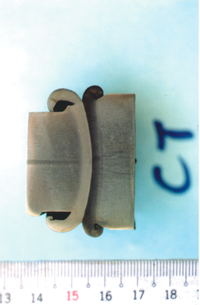
Welding Interface Analysis
Friction welding processing with precise recipe makes the strength of the welding interface higher than both the parent metal of rebar and coupler. The rationale includes two critical elements.
1. Increased microstructure density of welding interface
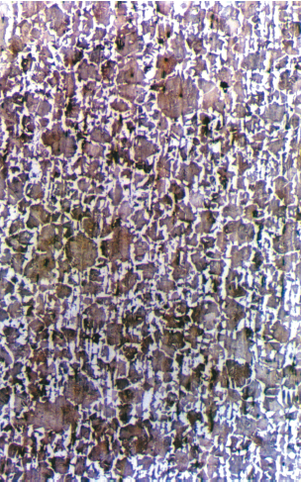
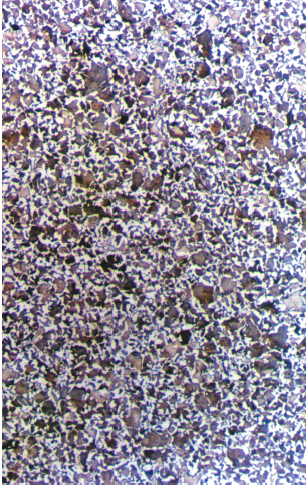
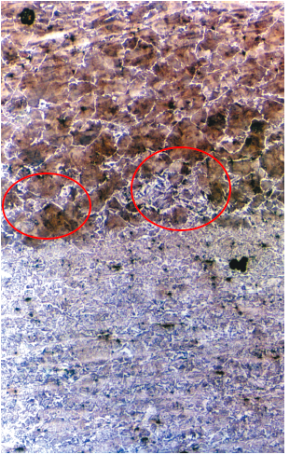
Figure 1-1 and Figure 1-2 in 100X magnification show the parent metal microstructure of high-strength rebar (tensile strength >= 620N/mm2) and the corresponding coupler respectively, and Figure 1-3 in the same magnification displays the welding interface microstructure between high-strength rebar and coupler. As you can see, the parts in the red circles of Figure 1-3 demonstrate that friction welding produces a well-mixed interface with two parent metal, contributing to a strong bonding. Furthermore, compared to Figure 1-1 and 1-2, the microstructure densities of rebar and coupler in Figure 1-3 both become higher after friction welding processing. Hence, the higher the density, the higher the strength of bond.
2. Increased loading section area
The loading section area of welding interface becomes larger after friction welding processing as shown in Figure 2, thereby providing a higher strength.
Based on the two above-mentioned keys, friction welding technology with precise recipe manages to effectively assemble rebar and coupler. Moreover, welding interface acts to provide higher yielding and tensile strengths than those of original rebar and coupler. Therefore, friction welding technology is reliable and persuasive.